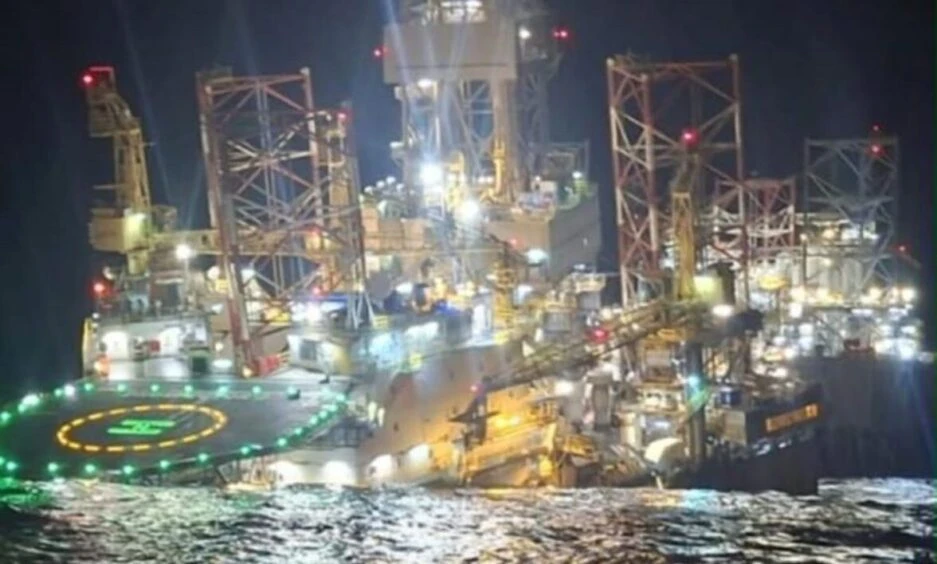
What happened offshore Gabon?
On 24 October 2026, the Prospector 5 jack-up drilling rig lost stability and sank offshore Gabon while preparing for a drilling campaign on the Dussafu Marine licence, off the coast of Mayumba.
The rig was owned and operated by Borr Drilling and contracted to support BW Energy’s offshore drilling operations. Both companies reported that the incident occurred at approximately 20:37 local time, during jacking operations before drilling began. [1][2]
Borr Drilling reported that preliminary information indicated a “punch through event during preload activities,” followed by loss of stability and sinking. The technical investigation will establish the underlying causes.
There were 115 people onboard. The companies’ initial statements said 110 had been safely accounted for, while five remained unaccounted for. Reuters subsequently reported that one worker had been found dead and four remained missing, citing a representative of a petroleum workers’ organisation. [3]
Emergency response teams were activated, with Borr Drilling, BW Energy and local authorities coordinating search-and-rescue efforts. Reuters reported that Gabon’s Ministry of Petroleum and Gas established a crisis unit, requested naval support and ordered a technical investigation.
BW Energy also reported that production at the nearby MaBoMo facility was shut down during drilling preparations. Its initial statement reported no damage to that facility or related equipment and no accidental discharge of harmful substances from the facility. [2]
SQMI extends its condolences to the bereaved family. Our thoughts are with the missing workers, their families, the survivors and the response teams.
The investigation: establishing the causes
The accident occurred during jacking and preload activities, before active drilling. Borr Drilling’s preliminary account identifies a punch-through as the event preceding the loss of stability.
The investigation must establish the seabed conditions, foundation performance, equipment condition, operational decisions and procedures relevant to the accident. No final investigation findings are included in the statements issued on 25 October 2026.
Establishing the root causes requires engineering evidence and operational records. The safety priorities discussed below are preventive guidance, not findings of fault.
What is a jack-up rig punch-through?
A jack-up rig is a mobile offshore installation with legs that extend down to the seabed. Once positioned, its hull is elevated above the water, with its weight supported through the legs and their foundations. The seabed must provide adequate support for the loads imposed during installation and operation.
A punch-through can occur when a foundation suddenly penetrates into weaker soil beneath a more resistant layer. If penetration is rapid or uneven between the legs, the rig can tilt and lose stability.
Preloading is a controlled installation activity that applies loads to the foundations before normal elevated operations. Its purpose includes establishing foundation performance under the planned loading conditions.
At Prospector 5, the investigation must establish the actual foundation behaviour and sequence of events.
1. Assess the seabed at the actual operating location
The following six priorities provide a basis for reviewing offshore safety arrangements. They are not findings that these controls were missing on Prospector 5.
Safe installation starts with understanding the conditions beneath the rig. Site-specific assessments should consider soil layers, predicted foundation penetration, seabed slopes, previous jack-up footprints and uncertainties in the available data. Experience at a neighbouring location cannot automatically demonstrate that another position is suitable.
A competent engineering assessment should establish whether the selected rig can be safely installed and operated at the proposed location. Significant uncertainties require further investigation, analysis and operational planning before installation.
2. Treat jacking and preloading as safety-critical operations
The period before drilling begins can involve major hazards. Jacking and preload operations require approved procedures, competent personnel, effective supervision and clear limits for loading, penetration and inclination.
Monitoring must be linked to defined actions. Unexpected foundation movement or unusual loading should trigger the response specified in the approved procedures, including stopping the operation where required.
A task does not become low risk simply because it is familiar or has been completed successfully before.
3. Make stop-work authority practical
Workers need to understand when and how to stop an unsafe operation—and trust that management will support an appropriate intervention.
Before a safety-critical activity begins, the team should know who controls the operation, which conditions require work to stop, how concerns must be communicated, who assesses changed conditions and who can authorise a restart.
A written stop-work policy is insufficient if production pressure discourages people from using it.
4. Align operator, contractor and emergency arrangements
Offshore operations bring together rig crews, field operators, marine support teams and specialist contractors. Their responsibilities must connect clearly, particularly during installation activities near existing facilities.
Effective coordination includes shared understanding of operating limits, communication channels, simultaneous operations and emergency escalation. It also requires clarity about who makes decisions when conditions change.
The operator and contractors should check that their procedures assign compatible responsibilities for stopping work, escalating an emergency and coordinating evacuation.
5. Prepare for rapid loss of stability
Emergency planning must consider conditions that could make normal escape and evacuation difficult. A tilted or unstable installation may affect movement, access to equipment and the availability of escape routes.
Organisations should test personnel accountability, alarm and communication systems, alternative escape routes, access to lifesaving equipment, coordination with rescue resources and credible night-time emergency scenarios.
Record the gaps identified during drills, assign corrective actions and verify that those actions have been completed.
6. Maintain environmental monitoring alongside rescue
Search and rescue is the immediate priority, but environmental protection must proceed alongside it. Potential pollution sources, response resources and nearby sensitive environments require continuing assessment.
Initial reports of no observed discharge are important, but they are time-specific observations, not a permanent conclusion that environmental consequences have been ruled out.
Offshore Safety Priorities for Gabon, Cameroon and the Gulf of Guinea
Employers commissioning jack-up operations in Gabon, Cameroon or elsewhere in the Gulf of Guinea should review site-assessment approval, preload monitoring and evacuation readiness before mobilisation and installation.
UK Health and Safety Executive guidance identifies structural integrity as essential to offshore workforce safety. It addresses foundation failure, jack-up leg and connection integrity, and risks associated with jacking and preloading. [4]
The HSE guidance is a technical reference, not a statement that UK legislation governs the Gabonese operation. Employers must also establish the national requirements applicable to their own activities.
The review should identify who approves the site assessment, who monitors foundation penetration and inclination, who can stop jacking, and how everyone onboard will be accounted for if the rig becomes unstable. The operator, rig contractor and marine-support teams should resolve gaps in these responsibilities before installation begins.
Strengthening safety competence with SQMI
Safety and Quality Management Institute (SQMI) is committed to promoting the health and safety of workers around the world. Through safety education, professional development and practical guidance, we encourage employers and workers to identify hazards, control risks and prevent harm.
The NEBOSH International General Certificate and NEBOSH HSE Certificate in Process Safety Management provide relevant learning pathways for developing occupational and process safety knowledge.
These qualifications do not replace specialist offshore engineering competence, role-specific training or operational authorisations. Explore SQMI’s courses and upcoming intakes, or contact infos@sqmicmr.org to discuss your training needs.
Incident information current to 26 October 2026. Casualty figures and operational details reflect the dated statements and reports cited.
Further updates on the Prospector 5 incident
Further verified information about the incident, the investigation and its safety implications will be communicated to readers through this page in due course. SQMI will update this article as authoritative information becomes available.
Updates will distinguish official investigation findings from preliminary company statements and media reports, with dated references so readers can identify the information used.
Quick checklist
- Which activities could cause a rapid loss of stability or structural support?
- Have the relevant ground conditions, equipment and loads been assessed?
- What changes would require the assessment to be reviewed?
- Are operating limits and stop-work conditions understood?
- Can everyone onboard be accounted for during an emergency?
- Have emergency exercises tested difficult conditions, not only ideal ones?
Common questions
- Which rig sank offshore Gabon?
- Prospector 5, owned and operated by Borr Drilling and contracted to support BW Energy’s offshore operations.
- When did the Prospector 5 accident happen?
- Borr Drilling and BW Energy reported that the incident occurred on 24 October 2026, at approximately 20:37 local time.
- Was the rig drilling when it sank?
- The companies described jacking operations in preparation for a drilling campaign. Reuters reported that drilling had not yet begun.
- Has the cause been confirmed?
- Borr Drilling’s preliminary account identifies a punch-through during preload activities. The underlying causes remain subject to investigation. SQMI will communicate further verified information through this page in due course.
Sources and further reading
- [1] Borr Drilling — Prospector 5 Rig Incident, 25 October 2026
- [2] BW Energy — Drilling rig incident on the Dussafu licence, 25 October 2026
- [3] Reuters via Internazionale — One person dead and four missing, 25 October 2026
- [4] UK HSE — Offshore structural integrity
- Photograph source: Energy Voice — publisher’s credit © Supplied by Contributed
This article is general guidance for awareness. Apply it through your own site-specific risk assessment and the laws and standards that apply where you work.