Practical workplace guidance
Safer handling is not simply a lesson in bending the knees. Employers and supervisors should first redesign the task so that people do not have to perform unnecessary or hazardous handling.
Start with three priorities: avoid, assess, reduce
Avoid hazardous manual handling where practical. Can the supplier deliver closer to the point of use? Can the process move materials mechanically?
Assess the handling that remains. Consider the whole activity, not just the weight of one item. Reduce the risk through better equipment, layout, load design and work organisation.
This approach applies to cement bags on a construction project, cartons in a distribution centre and supplies in a hotel or office. The controls must fit the actual workplace.
Assess the task, load, environment and person
Consult the people doing the work. Reports of pain, excessive fatigue or difficult handling are reasons to review the task—not to tell workers to try harder.
- Task: How often is the movement repeated? Does it involve twisting, reaching, long carries, uneven lifting or work above shoulder height?
- Load: Is it heavy, unstable, bulky, hot, sharp, slippery or difficult to grip? Could the contents shift?
- Environment: Are there slopes, stairs, poor lighting, obstacles, cramped spaces or slippery surfaces? Does heat increase fatigue?
- Person: Does the worker have the capability, training and support needed? Are individual health needs or work restrictions being addressed appropriately?
Use mechanical assistance and improve the layout
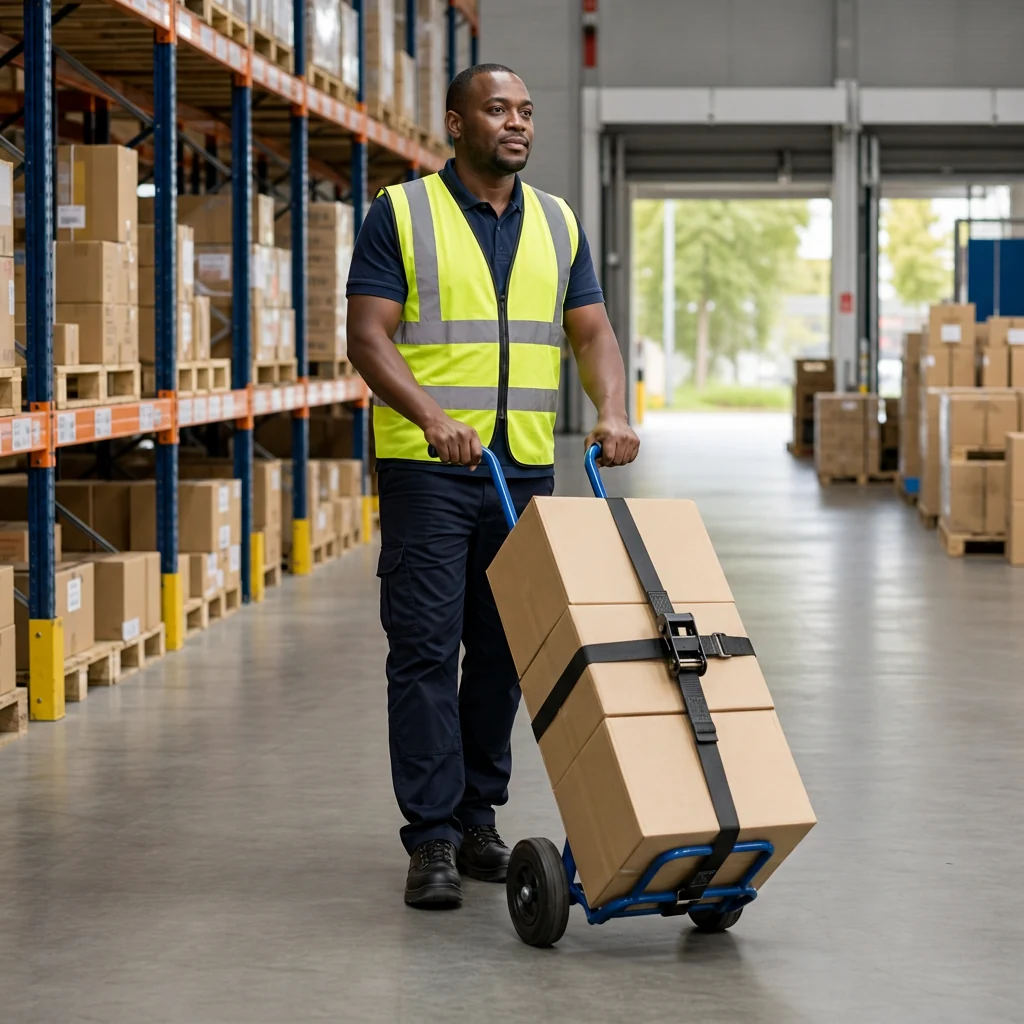
Choose a suitable trolley, pallet truck, hoist or other aid for the load and route. Check capacity, stability, condition and operator requirements. A mechanical aid should reduce the overall risk rather than introduce crushing, collision or overturning hazards.
Store frequently handled items at a practical working height, reduce carrying distances and break deliveries into manageable units where possible. Keep routes clear and allow enough time to work without rushing.
For pushing and pulling, consider wheel condition, starting force, slopes, stopping and visibility. A load that rolls easily on a smooth floor may be difficult to control on a ramp or uneven yard.
When a manual lift is appropriate, plan it
Confirm the destination and clear the route. Check the load and grip, keep it reasonably close to the body and use a stable stance. Move smoothly, avoid twisting while lifting and turn by repositioning your feet where practicable. Follow task-specific instruction rather than forcing every load into one prescribed posture.
Do not attempt a load that feels unsafe or blocks your view. Ask for the planned assistance or a different method. Team handling also needs an assessment, a clear leader, communication and coordinated movement; dividing a load between two people does not automatically make it safe.
Training supports good design—it cannot replace it
A lifting demonstration will not solve excessive load weight, poor storage, unrealistic targets or repeated handling without recovery. Supervisors should check how the job is actually done, maintain handling aids and act on concerns early. Workers experiencing pain should report it and seek appropriate medical or occupational-health advice.
Practical example: moving cartons from a delivery truck
Workers repeatedly carry boxes across a long yard and stack them above shoulder height. A better system may bring the delivery point closer, use a suitable handling aid and reduce the stacking height. Changing the layout can reduce exposure more effectively than repeating the instruction “lift properly”.
Improve everyday safety with SQMI
Build the skills to assess handling tasks through SQMI risk assessment training, or discuss team training focused on your workplace. SQMI is based in Douala and supports employers across Cameroon, CEMAC and West Africa.
Ask SQMI about your team’s safety training needs.
Quick checklist
- Can the handling be eliminated or mechanised?
- Are the load, frequency, route and individual needs assessed?
- Is a suitable handling aid available and maintained?
- Can storage height and carrying distance be improved?
- Can workers stop and report pain, instability or unsafe conditions?
Common questions
- What is the maximum safe weight to lift?
- There is no single weight that is safe for every person and task. Frequency, posture, reach, grip, environment and individual capability all affect the risk. Follow the task assessment and applicable requirements rather than treating a generic kilogram figure as permission to lift.
- Does a back belt make a heavy lift safe?
- No. A belt does not remove the need to avoid, assess and reduce hazardous handling. It should not justify heavier loads or replace an appropriate handling method.
- Is pushing always safer than pulling?
- No. The safest approach depends on equipment design, the route, required force, visibility and control. Assess both the movement and how the load will be stopped.
Sources and further reading
This article is general guidance for awareness. Apply it through your own site-specific risk assessment and the laws and standards that apply where you work.