Where AI can help workplace safety
Artificial intelligence can help teams find patterns in inspection records, identify equipment conditions that need attention and flag possible hazards in images. Cameras, wearables and maintenance systems are increasingly offered as safety tools. Used carefully, they may improve the information available to supervisors.
The ILO’s work on AI and digitalisation highlights both opportunities and new occupational risks. A Cameroon employer evaluating a product should start with a real problem, not a promise that technology will eliminate incidents. Ask which task will become safer and how the benefit can be checked.
Useful applications—and their limits
Predictive maintenance can flag unusual vibration or temperature, but a warning does not repair equipment or establish that a machine is safe. Competent maintenance, isolation and verification remain essential.
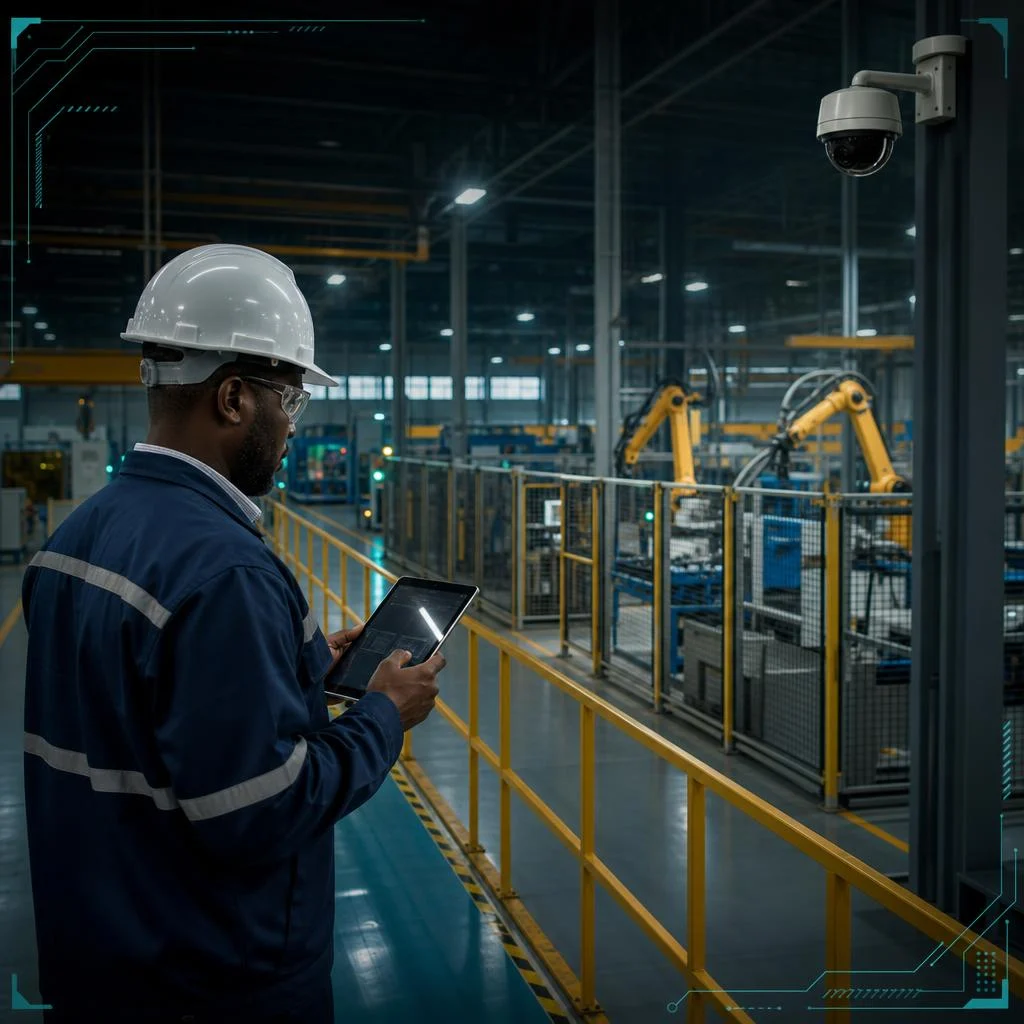
Computer vision can flag a person entering a restricted area or a missing item of PPE. It may also misinterpret shadows, crowded scenes, different clothing or partial views. A camera is not a substitute for barriers, safe traffic routes or properly selected protection.
AI can help draft a toolbox talk or summarise observations. It cannot inspect a workplace it has never seen, know whether an undocumented control works or take responsibility for a safe system of work.
Assess the risks the technology introduces
False negatives can miss a dangerous situation; false positives can create alarm fatigue. Poor connectivity, power interruptions, damaged sensors and software updates may alter performance. Consider what happens during a failure and ensure a safe way of working remains available.
Monitoring can also affect privacy, trust and mental health. If workers believe every movement will trigger punishment, they may avoid reporting problems. Consult employees and representatives, explain the purpose, minimise personal data and set appropriate access and retention arrangements.
Systems trained on unsuitable data may perform differently in local lighting, weather, workwear or languages. Test across actual operating conditions and relevant worker groups. Do not accept an overall accuracy percentage without understanding which errors are most safety-critical.
How to run a controlled safety-technology pilot
Define a narrow use case, such as detecting repeated pedestrian entry into a particular vehicle zone. Establish the current situation, the expected improvement and the person authorised to act on alerts. Use existing physical and organisational controls throughout the pilot.
Agree with the supplier how failures, cybersecurity issues and updates will be managed. Verify the alert-to-action process: who receives a warning, how quickly they respond and what they do if the system is unavailable. Avoid automatic safety-critical actions unless the complete system has been competently engineered and validated for them.
Compare observations with independent checks, record missed events and unnecessary alarms, and ask workers about unintended effects. Stop or redesign the pilot if it creates distraction, unfair treatment or a false sense of security. Success should mean safer work, not simply more data.
Can AI write your workplace risk assessment?
AI can suggest questions or help organise a draft. It can also invent legal requirements, miss local hazards and present unsupported statements confidently. Never submit an unverified generated assessment as evidence that the work has been competently evaluated.
A responsible assessor must observe the task, consult affected workers, verify applicable requirements and controls, and decide whether the remaining risk is acceptable. Do not upload confidential employee information, client records or sensitive site details into an external tool without authorisation and appropriate safeguards.
For SQMI learners and HSE professionals, the useful skill is critical judgement: knowing what to verify, which evidence is missing and when a competent specialist is required. Technology should strengthen that judgement, not replace it.
Quick checklist
- Define the specific safety problem and a measurable intended improvement.
- Consult workers and assess privacy, workload and fairness impacts.
- Test missed hazards and false alarms in real local conditions.
- Keep physical controls, human oversight and a safe failure plan.
- Verify every AI-generated legal claim and risk-assessment recommendation.
Common questions
- Can AI replace an HSE professional?
- It can support information gathering and analysis, but it does not replace competent assessment, consultation or accountable decisions about workplace controls.
- Is an AI camera a substitute for separating people and vehicles?
- No. Physical segregation and a suitable traffic-management system remain fundamental. Detection tools may provide additional support, not guaranteed protection.
- Is a vendor’s accuracy score enough to approve a system?
- No. Assess safety-critical errors, actual operating conditions, failure modes, updates and the response process, alongside worker and data-protection impacts.
- Can we upload employee incident reports into a public AI tool?
- Not without authorisation and appropriate safeguards. Review confidentiality, personal data, contracts and applicable requirements before using an external service.
Sources and further reading
This article is general guidance for awareness. Apply it through your own site-specific risk assessment and the laws and standards that apply where you work.