What happened at Metafrique Steel?
An explosion followed by a fire at Metafrique Steel S.A. in Douala’s Bassa industrial zone on 2 November 2026 killed at least four people and left 16 others severely burned, according to the Littoral governor quoted by Reuters. The injured were taken to Douala General Hospital. [1]
The latest disaster did not occur at a site without a history of fire. Public reporting identifies an earlier stock fire in April 2022 and a serious incident during the night of 30 April–1 May 2026. After the latter, management publicly said it had introduced stronger preventive measures. Six months later, workers were again killed and injured in a major fire. [2][3]
That sequence demands a documented answer: what was learned, what was changed, and who verified that the changes protected people?
Metafrique’s statement about the November incident refers to an external factor while saying the causes remain to be determined. This is the company’s account, not an established technical finding. SQMI has not identified a verified final investigation report for the November event. Information reviewed on 3 November 2026. [1]
Earlier Metafrique incidents: what the public record shows
The initial May injury count must not be presented as the final outcome. Later reporting described fatalities. Equally, unverified historical death counts should not be added together to produce a cumulative total.
The available reports do not establish that all three incidents had the same initiating cause. They do establish that repeated fires at the business merit examination of how investigations, corrective actions and operational restarts were managed.
| Date | Reported event | What the reporting establishes |
|---|---|---|
| April 2022 | Fire affecting raw-material stocks. | Business in Cameroon and Investir au Cameroun describe stock damage without reported casualties. These are retrospective reports, not an investigation report reviewed by SQMI. [2][4] |
| 30 April–1 May 2026 | A serious fire damaged part of the Bassa plant. | The initial report on 3 May described ten injured people and a temporary production shutdown pending investigation. Cameroon Tribune subsequently reported deaths and an investigation announced by the governor. A final casualty total is not established here. [2][3] |
| 4–5 May 2026 | Official visit and management assurance. | Cameroon Tribune reported the governor’s hospital visit on 4 May. Its 5 May report said management claimed stronger measures had been introduced to prevent another incident. [3] |
| 2 November 2026 | Explosion followed by fire. | At least four deaths and 16 severe burn injuries were reported. The governor criticised safety implementation after earlier fires. [1][4][5] |
Is Metafrique learning from previous accidents?
The public record raises serious questions about the effectiveness of learning and follow-through. It does not provide the evidence needed to conclude that no corrective action was taken.
There are two important accounts to examine. In May, management said stronger measures had been introduced. In November, Governor Samuel Dieudonné Ivaha Diboua was reported as saying that safety measures had not been taken despite earlier fires. That criticism must be attributed to the governor; it is not a substitute for the underlying inspection records or a court finding. [3][4][5]
For SQMI, learning is demonstrated by a change in operating conditions, not by the announcement of an investigation. A corrective action is effective only when the hazard is controlled and that control is verified in practice.
Without the relevant records, it would be premature to declare either that every lesson was applied or that nothing was done. The seriousness of the repeated harm nevertheless makes independent verification essential.
- What did the April–May investigation identify as the immediate and underlying causes?
- Which corrective measures were required, and which were completed before production resumed?
- Who checked the engineering safeguards, maintenance defects and emergency arrangements?
- What evidence supported restart, and were any significant defects still outstanding?
- Were workers and contractors consulted about recurring hazards and abnormal conditions?
- Did the November incident involve the same failed control, a different mechanism or weaknesses common to several operations?
What does Cameroon’s safety legislation require?
Cameroon has an existing legal framework for workplace safety and dangerous industrial establishments. The question is not simply whether rules exist, but whether the relevant requirements were implemented and enforced.
This section summarises the cited legal texts and their relevance. It does not determine Metafrique’s legal liability or replace a review of the installation’s permits, applicable amendments and investigation findings.
1. Imminent danger calls for immediately enforceable measures
Article 95(3) of Law No. 92/007 of 14 August 1992, the Labour Code, provides for labour inspectors or medical labour inspectors to order immediately enforceable measures where workers face imminent danger to health or safety.
Article 96 also provides for inspectors to require remedies where working conditions judged dangerous are not covered by specific regulations. The absence of a rule naming one particular machine or scenario is therefore not a reason to leave an identified danger unaddressed. [6]
2. Prevention includes protection, information and worker participation
Order No. 039/MTPS/IMT of 26 November 1984 sets out general workplace hygiene and safety measures. WageIndicator’s Cameroon legal summary identifies employer responsibilities for prevention, provision and maintenance of effective protection, and information about occupational risks on recruitment or introduction of a new process.
It also describes a health and safety committee requirement for establishments employing at least 50 workers, including investigation of serious workplace accidents and proposals to prevent recurrence. Whether those arrangements existed and operated effectively at this site must be established from records, not assumed. [7]
3. Classified establishments must prepare for emergencies
Article 12 of Law No. 98/015 of 14 July 1998 requires operators of classified establishments to draw up an emergency plan covering alerts to competent authorities and neighbouring residents, evacuation of personnel and means to contain a disaster.
The plan requires approval by competent services. The law also provides for periodic checks of the condition and reliability of the equipment needed to implement it. A document on a shelf does not demonstrate that alarms, escape routes, response equipment and coordination will work during an emergency. [8]
4. Inspection must include technical compliance
Articles 18–19 of Law No. 98/015 provide for inspection by sworn officials of the responsible ministry or other competent services. Their functions include checking operations, conducting audits, reporting and ensuring compliance with technical requirements. Article 19(2) provides for visits at any time and at least once every six months. [8]
The relevant questions include when the plant was last inspected, what defects were identified, what deadlines were set and how their correction was verified. The recurrence of a fire does not, by itself, prove that an inspection was missed.
For Class I establishments, Articles 4–6 also address prior authorisation, a danger study and operating conditions. SQMI has not reviewed Metafrique’s actual classification, authorisation or site-specific prescriptions; those documents would be needed to assess compliance at this installation. [8]
5. The law provides enforcement powers—not automatic guilt after an accident
Article 16 provides a ministerial power to close a classified establishment whose operation endangers the interests protected by the law. Article 28 provides a notice-and-enforcement procedure for non-compliance, including possible suspension until prescribed conditions are met. These provisions should be read alongside the Labour Code’s immediate-danger powers. [6][8]
Article 34 specifies penalties for particular offences, including operating without the required authorisation or declaration, continuing operation after a closure order and obstructing inspection. These are not automatic penalties for every industrial accident. Repeated fires are not, by themselves, proof of a repeated criminal offence. Liability and sanctions depend on established facts and the applicable legal process. [8]
Investir au Cameroun reported on 3 November that the governor had called for the plant to stop, while noting that a formal administrative closure instrument had not been verified. KOACI described an order to cease activities. Until the operative decision is available, SQMI does not claim to have verified a formal closure order. [4][5]
6. Injured workers need organised medical support
Labour Code Article 98 requires an enterprise medical and sanitary service, with arrangements further addressed in Article 99. Article 102 addresses evacuation to an appropriate nearby medical facility where the employer’s available means cannot provide the necessary treatment. Medical preparedness is a planned responsibility, not something to organise for the first time after a major fire. [6]
Lessons industrial employers should apply now
These are SQMI’s prevention recommendations for comparable operations, not findings about the cause of the Metafrique accident.
An investigation must lead to verified changes
Every significant finding needs an owner, a completion date and evidence of effectiveness. Reissuing a procedure or briefing workers is not enough where the finding requires equipment repair, engineering separation or a redesigned process.
Restart must be a safety decision
Before a serious-event restart, management should document why the installation is ready: critical defects resolved, safeguards tested, operating limits defined and emergency arrangements verified, with any required authority approvals obtained. This is SQMI’s recommended management standard, not a claim that the law requires the same checklist at every facility.
Engineering controls must carry the main protection
Depending on the actual hazards, verify material acceptance, dry storage, cooling-system integrity, electrical protections, isolation, interlocks, separation and access control. PPE remains necessary where assessed, but it cannot replace prevention of a high-energy release.
Water contacting molten metal is a recognised explosion hazard in HSE guidance. It is a general hazard to evaluate—not an established cause of either Metafrique accident. Firefighting methods must be selected by competent specialists for the actual process; suppression around molten metal must never be improvised. [9]
Workers must be able to report and stop dangerous work
Workers and contractors often see recurring defects and abnormal conditions first. A practical stop-work and escalation process should make concerns visible to management and ensure that production does not resume merely because someone has reset an alarm.
Oversight must verify outcomes
The employer must implement effective controls, while inspectors must exercise their oversight functions. Neither an inspection visit nor an action marked ‘closed’ proves that risk has been reduced. Records should show what was checked, what failed and how the repair or improvement was tested.
Metafrique photographs and original reporting
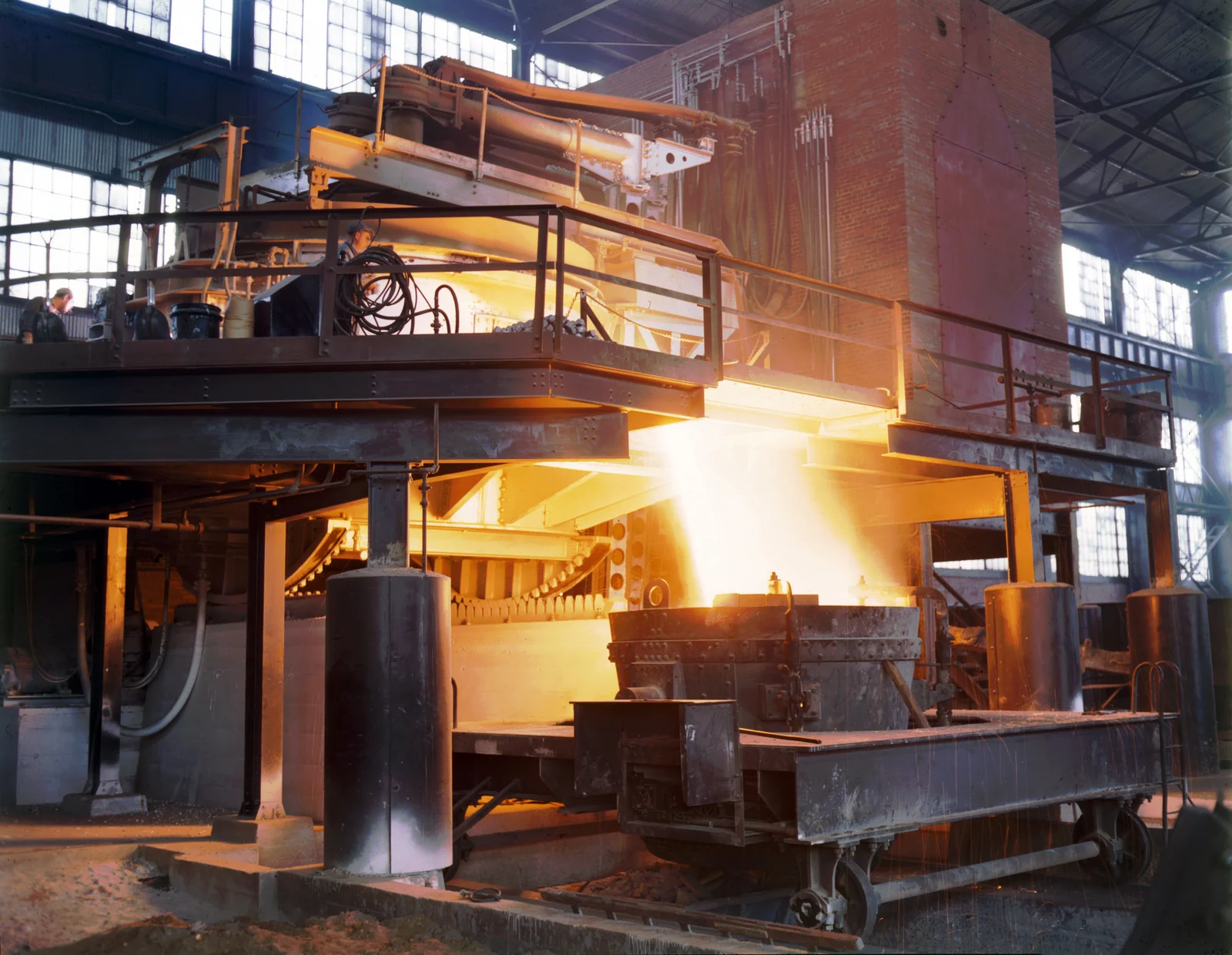
Investir au Cameroun’s report includes a photograph associated with the Metafrique fire. Open source [4] below to view the original publisher’s page. SQMI has not independently established that photograph’s original capture date, photographer or republication licence; it is linked rather than reproduced here. The opening photograph is a public-domain historical steelmaking illustration from Pennsylvania, not Metafrique or the Douala accident. Its creator and original source are credited in the caption.
SQMI’s position
Workers should not have to rely on an assurance that lessons have been learned. They should be protected by safeguards that have been installed, maintained, tested and independently scrutinised where necessary.
Metafrique’s earlier fire history and the governor’s reported criticism justify firm questions about prevention and follow-through. They do not justify inventing a technical cause or declaring criminal responsibility before the evidence is examined.
Safety and Quality Management Institute is committed to promoting the health and safety of workers around the world. Further verified information about this incident, including official investigation findings and the status of enforcement measures, will be communicated through updates to this article.
Quick checklist
- Obtain previous investigation findings and the corrective-action register.
- Check evidence of completed engineering and maintenance improvements.
- Verify critical safeguards before restart.
- Confirm the approved emergency plan and response-equipment readiness.
- Review inspection findings and evidence that defects were resolved.
- Include workers and contractors in hazard reporting and prevention.
- Retain named responsibility, deadlines and effectiveness checks for every significant action.
Common questions
- Has Metafrique Steel in Douala experienced earlier fires?
- Public reporting describes an April 2022 stock fire and a serious fire during the night of 30 April–1 May 2026, before the 2 November 2026 explosion and fire. Those reports do not establish that all incidents had the same cause.
- Did the May 2026 Metafrique fire cause deaths?
- The initial 3 May report described ten injured people. Cameroon Tribune’s 5 May reporting subsequently described fatalities. SQMI has not established a verified final death toll and does not present the initial injury count as the final outcome.
- Were safety improvements made after the earlier fire?
- Cameroon Tribune reported management’s May assurance that stronger measures had been introduced. The governor’s November criticism raises questions about implementation. Investigation records, completed actions and verification evidence are needed to assess what changed and whether it worked.
- What does Cameroon’s Labour Code say about imminent danger?
- Article 95(3) of Law No. 92/007 provides for labour inspectors or medical labour inspectors to order immediately enforceable measures where workers face imminent danger to health or safety.
- Do classified industrial establishments in Cameroon need emergency plans?
- Article 12 of Law No. 98/015 requires an emergency plan addressing alerts, evacuation and disaster containment, approval by competent services and periodic checks of the equipment needed to implement it.
- Has the cause or a formal closure order been verified?
- SQMI has not identified a verified final technical cause. Reports describe the governor calling for activities to stop, but the formal administrative instrument has not been verified in the material reviewed. Further confirmed developments will be added to the article.
Sources and further reading
- [1] Reuters via MINING.COM — Explosion kills four at Cameroon iron smelting plant, 2 November 2026
- [2] Business in Cameroon — Fire at Metafrique Steel injures at least 10, halts production, 3 May 2026
- [3] Cameroon Tribune — Metafrique Steel Fire Incident: Investigations Opened, 5 May 2026; accessible introduction
- [4] Investir au Cameroun — Metafrique: repeated fire and governor’s response, 3 November 2026; photo source
- [5] KOACI — Metafrique fire and governor’s statements, 2 November 2026
- [6] Ministry of Labour — Labour Code, Law No. 92/007 of 14 August 1992, Articles 95–96, 98–99 and 102
- [7] WageIndicator — Cameroon health and safety legal summary, citing Order No. 039/MTPS/IMT of 26 November 1984
- [8] Ministry of Environment — Law No. 98/015 of 14 July 1998 on classified establishments, official English text
- [9] UK HSE — Safety hazards in the molten metal industries; technical guidance, not Cameroonian law
This article is general guidance for awareness. Apply it through your own site-specific risk assessment and the laws and standards that apply where you work.