What happened during Friday’s nationwide ground stop?
On Friday, 13 November 2026, the Federal Aviation Administration (FAA) issued a nationwide ground stop for departing flights after communication issues affected multiple Air Route Traffic Control Centers. These centres manage aircraft moving through U.S. airspace.
The FAA’s initial statement described the information as preliminary and said technicians were investigating. The agency lifted the ground stop at 8:15 p.m. Eastern Time, after more than four hours. The restriction applied to departures; it did not mean every aircraft already in the air was ordered to land immediately.
Transportation officials said aircraft were able to land safely during the disruption. The immediate restrictions ended, but airlines continued to deal with cancellations and schedule disruption as they repositioned aircraft and crews. ABC News reported more than 14,000 flight cancellations across Friday and Saturday. [1][2]
What caused the FAA flight shutdown?
The precise cause had not been established in the information available by 15 November. Officials described a telecommunications or equipment outage. Transportation Secretary Sean Duffy said routers became overloaded and produced inconsistent data. On Saturday, he said the problem arose during work to replace copper wiring with fibre at a remote FAA site; investigators were still examining whether it involved a router, installation or configuration. [2][3]
The Professional Aviation Safety Specialists union, which represents FAA technical workers, said its members were not involved in the upgrade work. That statement raises questions about coordination between contractors and the agency, but it does not by itself establish the cause of the outage or assign responsibility. [3]
A public explanation of a suspected failure path is not the same as a completed technical investigation. The FAA’s first notice called the information preliminary. The failure mechanism, its effects on other facilities and the effectiveness of safeguards still require clear answers.
Was the U.S. aviation outage a cyberattack?
In reports available by 15 November, U.S. officials said they had seen no evidence of a cyberattack or other deliberate act. This is an important update, but it should not be confused with a final investigation report. The cause remained under review. [2][3]
Aviation security includes protecting systems against deliberate interference. It also includes ensuring critical services remain dependable when equipment fails, a network change goes wrong or a supplier’s infrastructure is disrupted. Investigators need to examine security concerns carefully while also assessing technical reliability, maintenance controls and system design.
Why stopping departures can be a safety measure
When controllers cannot rely on the communications or data needed to manage traffic safely, restricting departures can be a necessary protective measure. A ground stop is disruptive, but allowing more aircraft into an uncertain operating environment could increase risk.
The safety question is not simply why flights were stopped. It is whether the systems supporting safe traffic management had sufficiently independent safeguards, whether the failure was detected quickly and whether decision-makers had reliable information. Officials said aircraft landed safely; that outcome should be considered alongside a full review of what failed and how the network was protected from wider disruption.
Five lessons for aviation infrastructure and safety management
The incident points to practical questions for any organisation that depends on safety-critical communication networks:
- Treat network upgrades as safety-critical work: assess risks in advance, test under realistic conditions, deploy in controlled stages and maintain a tested rollback plan.
- Verify that backup systems are independent. Shared network paths, configurations, power supplies or failure modes can undermine apparent redundancy.
- Coordinate contractors and in-house teams. Agree on roles, operational risks, acceptance checks, escalation contacts and who can pause or reverse a change.
- Prepare for degraded operations and recovery. Test reduced-capacity procedures, clear communications and a coordinated restoration sequence.
- Protect people during prolonged disruption. Monitor crew duty limits and fatigue, and plan support for passengers who need additional assistance.
Consider passengers and workers through the recovery phase
A disruption can leave people waiting for hours, including older passengers, people with disabilities, children and travellers who need medication or other assistance. Passenger information, access to support and management of crowded terminals are part of the wider emergency response. Controllers, airline and airport staff also need recovery plans that account for workload and fatigue.
Publish findings and verify corrective actions
A useful investigation should explain the failure path, identify any gaps in change control or system resilience and set out corrective actions. Their effectiveness should be checked after implementation. Replacing equipment may be part of the solution, but procedures, staffing, contractor coordination and safeguards around future upgrades also need review.
What travellers should know
The FAA lifted the nationwide ground stop on Friday evening. Cancellations and delays continued as airlines worked to restore their schedules. On Saturday, the FAA administrator said airlines expected to recover their schedules by the end of Sunday; this was a forecast, not a guarantee that every affected passenger would travel normally. [3]
Passengers affected by disruption should check directly with their airline for current flight status and rebooking instructions before going to the airport. Policies and options vary by carrier.
System resilience is essential to aviation safety
The 13 November ground stop shows how a technical problem in a communications network can disrupt air travel far beyond the site where the fault begins. A safety-first decision to pause departures may reduce immediate operational risk. Long-term confidence depends on understanding how the outage occurred, how far it could have spread and whether safeguards can prevent a repeat.
SQMI is committed to promoting the health and safety of workers around the world. We will share further verified information about this incident as it becomes available.
Quick checklist
Common questions
- Did the FAA shut down all U.S. flights?
- The nationwide ground stop applied to departing flights. It did not mean that all aircraft already airborne were ordered to land.
- What caused the November 13 FAA ground stop?
- The outage affected air traffic control communications. Officials discussed equipment and network problems, but the final cause had not been established in the information available by November 15.
- Was the U.S. flight shutdown caused by a cyberattack?
- Officials said they had seen no evidence of a cyberattack. The investigation was continuing, so early statements should not be treated as a final report.
- Did flights resume after the ground stop?
- The FAA lifted the ground stop at 8:15 p.m. Eastern Time on November 13. Airlines continued to manage cancellations and delays afterward.
Sources and further reading
- [1] FAA — Statement on Nationwide Ground Stop; initial notice, identified as preliminary
- [2] Reuters — U.S. grounds flights nationwide after air traffic control communications outage; 13 November 2026
- [3] ABC News — FAA ground stop updates, including recovery outlook and the PASS union statement; updated 14 November 2026
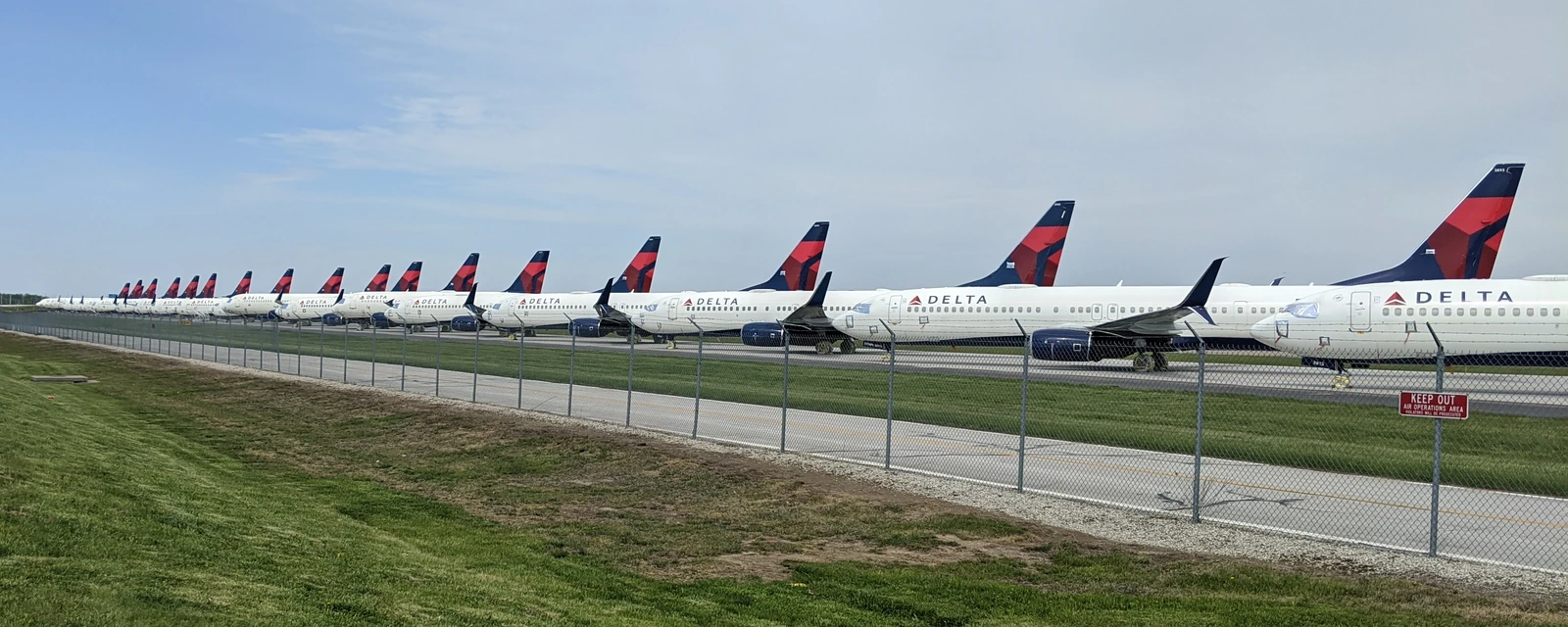
- Archive illustrative photograph — elisfkc2, Delta aircraft parked at Kansas City International Airport during the COVID-19 pandemic, 9 May 2020
- Image licence — Creative Commons Attribution-ShareAlike 2.0 Generic; applies to the resized WebP adaptation
This article is general guidance for awareness. Apply it through your own site-specific risk assessment and the laws and standards that apply where you work.